
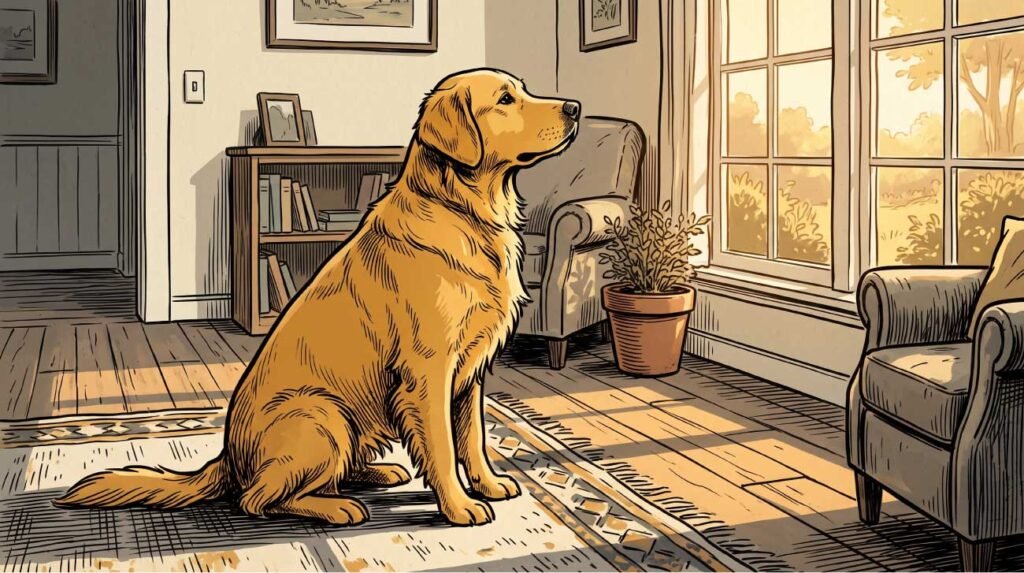
If your dog starts pacing near their food bowl a few minutes before dinner, or lifts their head off the couch minutes before your car turns onto the street, you’ve probably wondered the same thing most dog owners eventually ask: does my dog actually know what time it is?
The short answer is yes — dogs have a genuine sense of time. But the way they experience it has almost nothing to do with clocks, and almost everything to do with their body, their nose, their ears, and their nervous system working together in ways researchers have only recently been able to measure precisely.
Watch: What Your Dog Does 10 Minutes Before You Come Home
Dogs Don’t Read Clocks — They Read Change
Dogs can’t understand time the way we do, as a sequence of numbered hours. What they track instead is change — in light, in scent, in their own body, and in the rhythm of your household.
This tracking runs on their circadian rhythm, the internal biological clock that governs sleep, hunger, digestion, and alertness over a 24-hour cycle. Morning isn’t «7 a.m.» to your dog — it’s a shift from dark to light, a change in hormone levels, the specific sound of your household waking up. Dinner isn’t «6 p.m.» — it’s the feeling of an empty stomach combined with the light outside reaching a certain angle.
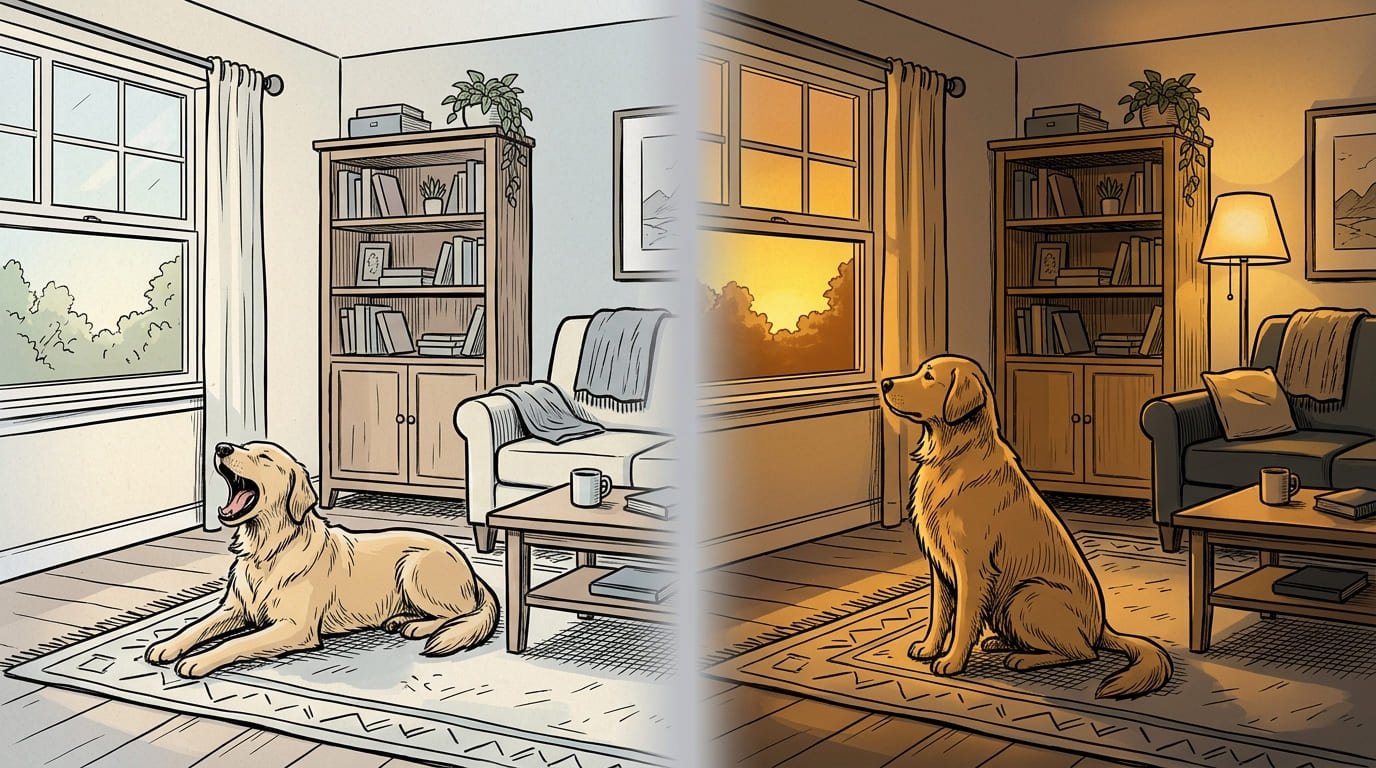
This is why dogs adapt so precisely to routine, and why disruptions to that routine — a schedule change, a trip, a new work shift — can genuinely unsettle them. Their sense of time isn’t abstract. It’s built from real, physical signals, and when those signals stop lining up with what their body expects, they notice.
The Real Engine Behind Dog Time-Tracking: Scent
The most well-documented mechanism behind a dog’s sense of time is scent — and it’s more precise than most owners realize.
Research from Alexandra Horowitz’s Dog Cognition Lab at Barnard College has shown that dogs have between 220 and 300 million olfactory receptors, compared to roughly six million in humans. But raw sensitivity isn’t the interesting part. What matters is how dogs use that sense to track time passing.
When you’re home, your scent is at its strongest throughout your house. Once you leave, that scent begins to fade — slowly, predictably, along a measurable curve. A dog’s nose can track that fade with enough precision to estimate roughly how long you’ve been gone, and roughly when you’re likely to return.
Research building on this — including work from Northwestern University and later expanded at the University of Virginia on what’s known as circadian scent tracking — found that dogs who had learned a person’s schedule began showing anticipatory behavior (moving toward the door, becoming more alert, vocalizing) precisely when their scent faded to the level typically associated with that person’s expected return time.
In other words: your dog isn’t watching a clock. They’re smelling one.
This also explains something many owners notice but rarely understand: dogs seem to «know» when you’re running late. If your scent has already faded past the point your dog’s internal model expects, their biological clock has effectively passed its alarm — which is why dogs sometimes appear more restless or anxious the longer a departure runs past its usual length.
What PetMD and Most Sources Leave Out: The Chemistry of Anticipation
Most articles on this topic stop at scent and circadian rhythm. But scent tracking is only the detection system. What happens next, inside your dog’s body, is where the science gets genuinely remarkable — and where most coverage of this topic stops short.
A 2019 study published in Frontiers in Psychology, using non-invasive saliva sampling in dogs during separation-and-reunion protocols, found that oxytocin — the hormone most associated with social bonding and trust — begins rising before a reunion happens, not during it. At the same time, cortisol, the primary stress hormone, begins to decline in dogs with a secure attachment to their owner as the expected return time approaches.
This means a dog’s sense of time isn’t just cognitive. It’s neurochemical. Their body is not simply calculating an estimate — it’s physically preparing for your return, releasing the chemistry of connection and calm in anticipation of you specifically, sometimes ten to thirty minutes before you arrive.
Sound Is the Second System — and It’s More Specific Than You’d Think
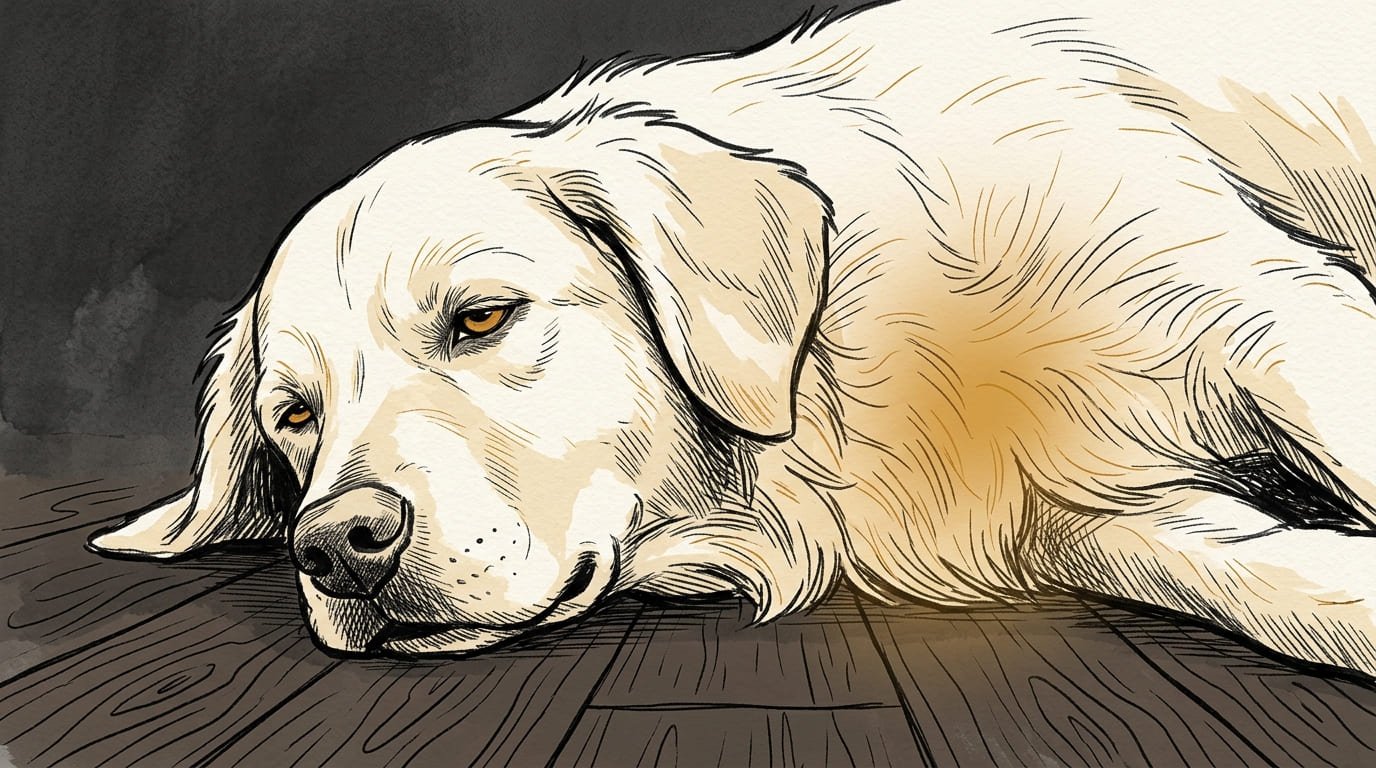
Scent tells a dog roughly when to expect you. Sound confirms it’s actually you.
Research from the Family Dog Project at the University of Budapest fitted dogs with EEG monitors while playing recordings of familiar and unfamiliar footsteps, car engines, and keys. Dogs showed significantly elevated neural activation — a measurable brain response — specifically to sounds associated with their primary attachment figure, and not to acoustically similar sounds from other people.
This means your dog hasn’t just learned to recognize «a car» or «footsteps.» They’ve built a detailed acoustic profile of you — your engine, your gait, the particular sound your keys make — precise enough to distinguish from anyone else’s, even through walls or traffic noise. The moment your dog’s ears lift at the end of the block, before you’ve made a sound you’d expect them to notice, they’ve identified something specific to you, not a category of person.
The Behavior You Can Actually See: Anticipatory Posture
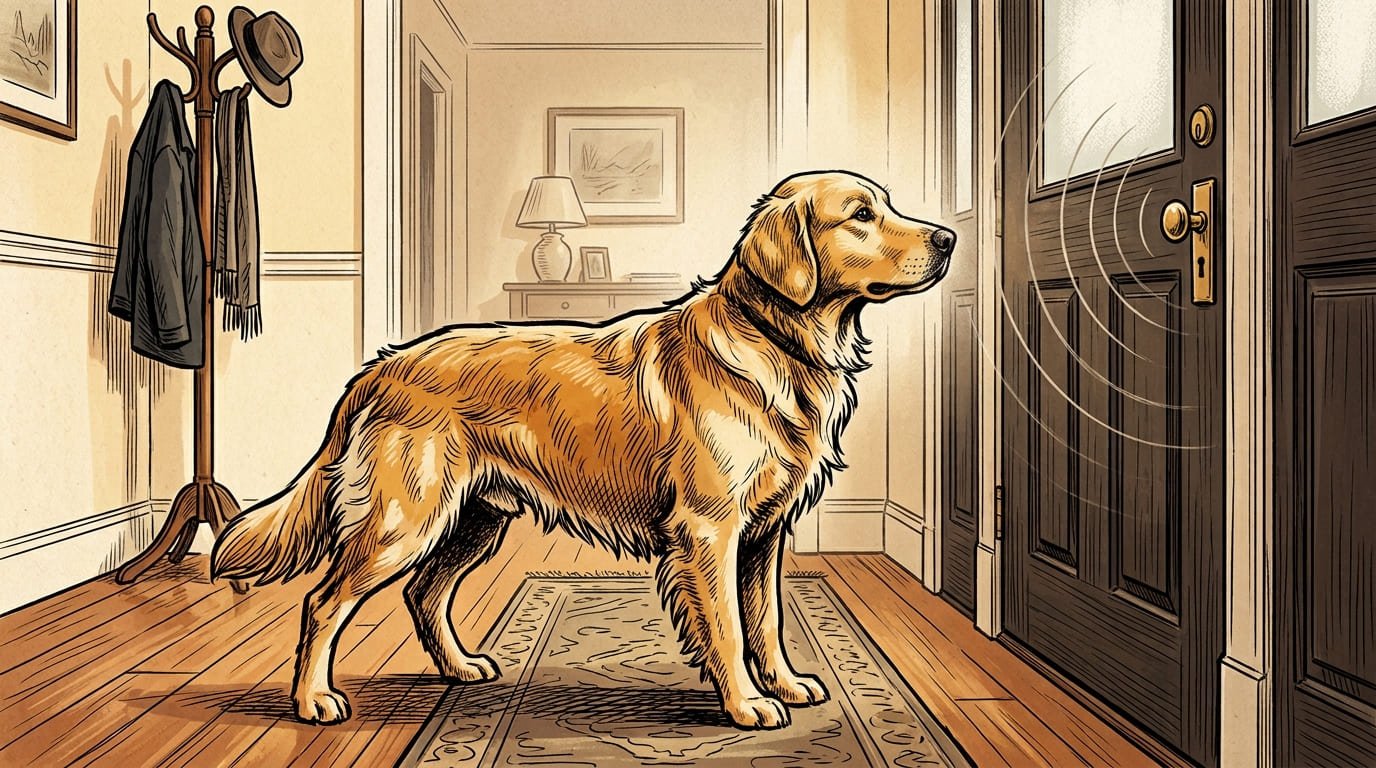
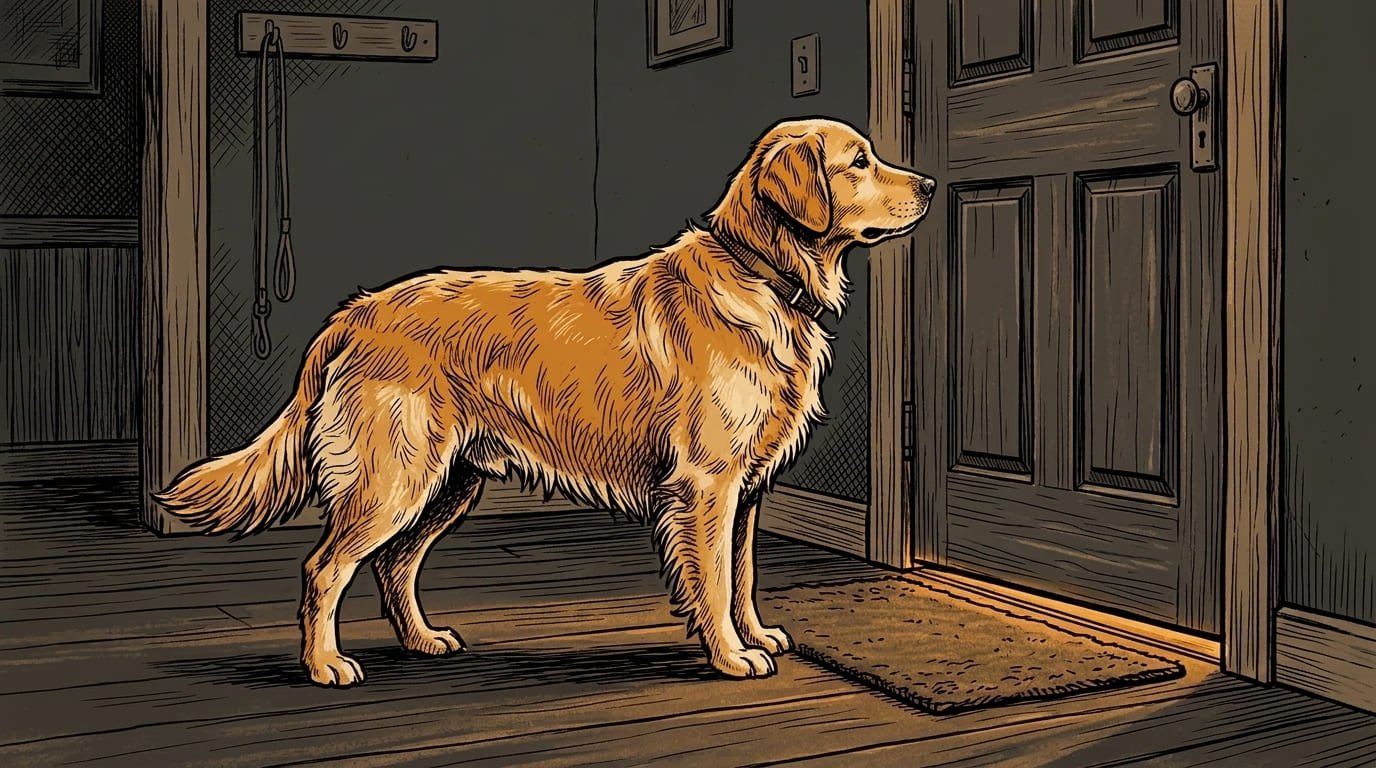
In the final minute or so before a dog’s person arrives, ethologists have documented a specific, observable posture called anticipatory orientation. The dog positions their body toward the expected point of entry, their weight shifts slightly forward, their ears go fully forward, and their tail may begin a slow, low movement — distinct from the full-body excitement of an actual greeting.
This posture is different from how a dog reacts to any random noise or approaching stranger. It’s specific to the anticipated arrival of someone they’re deeply bonded to — which means it’s one of the more reliable outward signs that all the internal systems above (scent tracking, neurochemistry, acoustic recognition) are actively working together.
If you have a home security camera, this is easy to verify yourself: check the footage from the five minutes before you typically arrive on an ordinary day. Most owners are surprised by how early the shift happens — and by how calm, rather than anxious, that waiting posture actually looks once you know what you’re seeing.
How This Compares to Human Time Perception
One frequently cited detail is that dogs, with a faster metabolism than humans, may experience time passing more slowly — meaning an hour that feels like 60 minutes to you may register closer to 75 minutes to your dog. That’s a useful way to think about why a two-hour absence can visibly affect a dog’s greeting behavior more than a twenty-minute one: research has found that dogs display measurably more greeting behavior after a longer absence, even though they can’t consciously count the hours.
But metabolism alone doesn’t explain the anticipation described above — that requires the combination of scent memory, circadian tracking, neurochemistry, and acoustic recognition working together, which is what separates true «knowing you’re about to arrive» from simply «reacting once you’re home.»
What This Means for You
Put together, the research paints a picture that’s more sophisticated than «dogs have an internal clock.» Your dog is running a layered system — scent fading on a predictable curve, a circadian rhythm tuned to your household’s patterns, rising oxytocin and falling cortisol as your return approaches, an acoustic profile built specifically around you, and a body posture that shifts to reflect all of it — hours before you actually walk through the door.
Science doesn’t use the word love to describe this. But what it documents is a body that has organized itself around you: using you as a reference point, a biological regulator, and the answer to a question it asks all day — when does the person come back?
This article is based on our video What Your Dog Does 10 Minutes Before You Come Home — subscribe on YouTube for new videos every week.
Want the complete science of what your dog feels about you? Get The Bond Guide — free, 5 chapters, 30 seconds to download.