
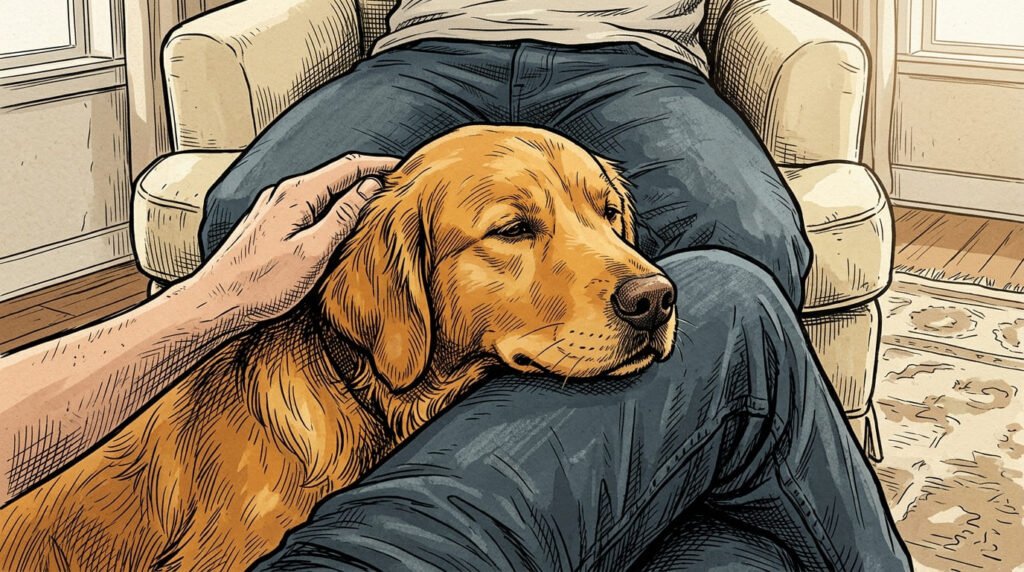
Your dog has probably done it to you. Maybe after a long day, maybe while you were sitting on the couch or the floor or the edge of the bed — your dog came over, not for food, not for a walk, not for anything you could name, and pressed their head against you. And went completely still.
Not a nuzzle. Not a quick nudge. Something more deliberate — full-contact weight, followed by stillness. Most people pet their dog, say something soft, and move on. But they don’t forget the moment. Something about it felt like it meant something.
It did. Here’s what canine behavior research actually says is happening.
Watch: If Your Dog Has Ever Pressed Their Head Against You and Gone Completely Still
First, an Important Distinction
Before going further, there’s one thing worth clearing up, because the phrase «head pressing» also describes something completely different: a real medical condition.
Medical head pressing is a neurological symptom — a dog repeatedly pressing their head against a wall or corner, often with a blank or disoriented look, for no apparent reason. That’s a veterinary emergency and can indicate neurological damage, liver disease, or toxic exposure. If you see that specific pattern, contact your vet immediately.
What this article covers is something entirely different: behavioral contact-seeking, sometimes called proximity-pressing. A dog that comes to you deliberately, presses their head against a specific part of your body, and settles — with soft eyes, a relaxed body, and clear awareness of who they’re with. It’s intentional, it’s communicative, and — as the research below shows — it’s one of the clearest outward signs of a secure bond a dog can offer.
The Framework Behind It: Attachment Theory
To understand why dogs do this, it helps to start with attachment theory, a framework developed by psychologist John Bowlby in the 1950s to explain the emotional bonds between infants and caregivers. The core idea: when something feels uncertain or stressful, an organism seeks proximity to its attachment figure — the individual it has identified as its safe base.
Starting in the late 1990s and 2000s, researchers began applying this framework to dogs, using an adapted version of the Strange Situation Procedure — originally designed to study infant attachment — in a series of separation-and-reunion scenarios. Findings published in journals including Animal Cognition and Applied Animal Behaviour Science were consistent: dogs form genuine attachment bonds with their primary caregivers, show distress when separated from them, and seek proximity upon reunion. Critically, securely attached dogs use their person as what researchers call a safe haven during stress.
That concept — safe haven — is the key to understanding what’s happening when your dog puts their head on your lap and goes still. The attachment figure isn’t just a source of food or shelter. They function as a biological regulator: a presence that signals to a dog’s nervous system, you are safe, this is manageable, you can rest.
What’s Actually Happening in Your Dog’s Body
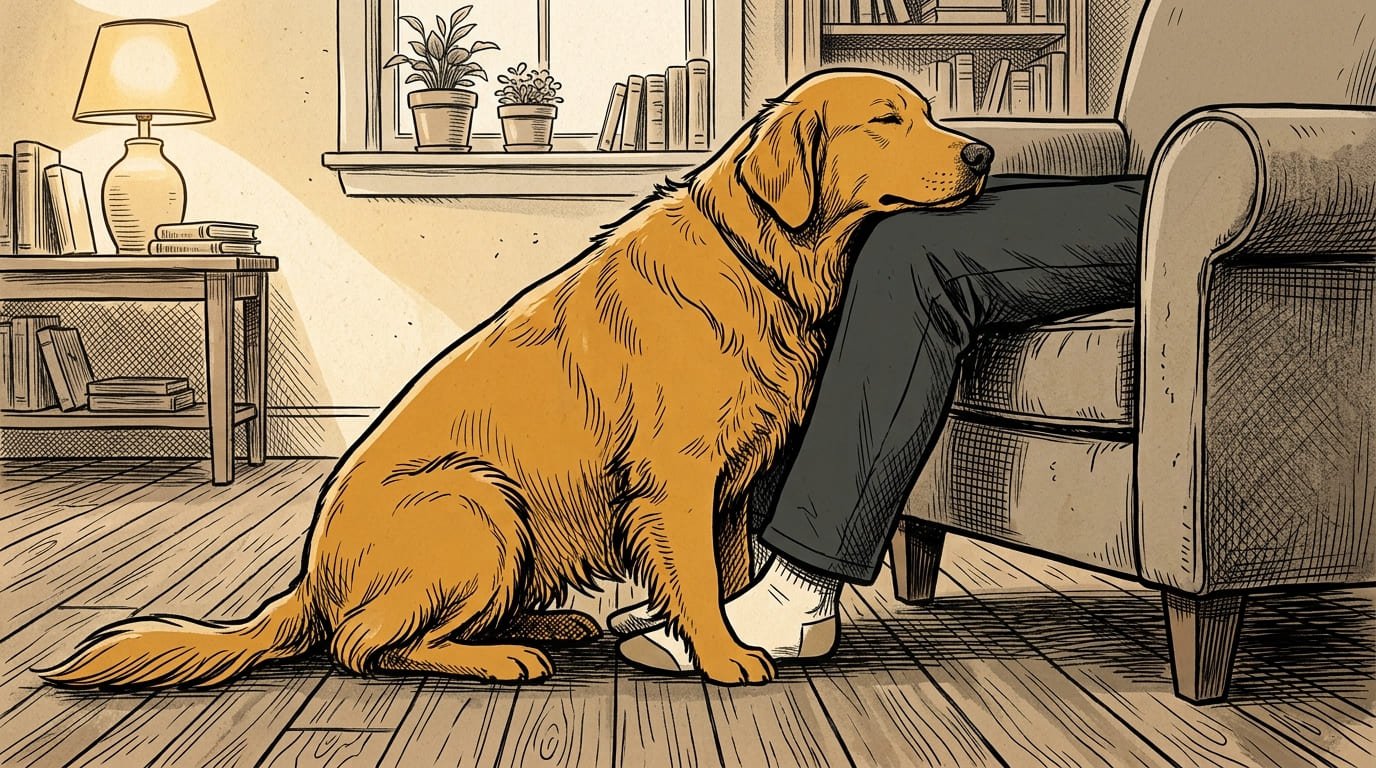
When a dog makes sustained, deliberate physical contact — like resting their head on your lap — a specific sequence of neurochemical events follows.
The first is oxytocin release. A 2015 study published in Science by researchers at Azabu University in Japan measured oxytocin in both dogs and their owners during interaction, and found that prolonged mutual gaze and physical contact triggered oxytocin increases in both — meaning the bond in that moment isn’t one-directional. When your dog rests their head on you, you’re both releasing the chemistry of connection at the same time.
The second is a measurable drop in cortisol, the primary stress hormone. Research from the University of Vienna’s Clever Dog Lab, published in Applied Animal Behaviour Science, found that physical contact with a securely attached person reduces cortisol in dogs within minutes.
The third is a shift in heart rate variability, a marker of nervous system regulation. Dogs in sustained contact with their attachment figure show increased heart rate variability — a sign their body is shifting from sympathetic arousal (alert, on-guard) toward parasympathetic rest (calm, settled).
In other words: the stillness that follows isn’t just behavioral. It’s physiological. Your dog’s nervous system is genuinely calming down, in response to you specifically.
When It Happens: Three Common Triggers
Dogs don’t rest their head on you at random. Research on proximity-seeking behavior has identified three recurring situations that trigger it.
Stress or uncertainty. When a dog encounters something unfamiliar or unsettling — a storm, a new environment, a stranger — a securely attached dog will often seek their person specifically to press against and be still, not to play or be entertained. This is the safe haven response in action.
Emotional overwhelm that’s resolving. Dogs often settle their head on their person after intense excitement has peaked — after a long walk, meeting other dogs, or unusual stimulation. The gesture functions as a way of returning to baseline, using the attachment figure as a regulator.
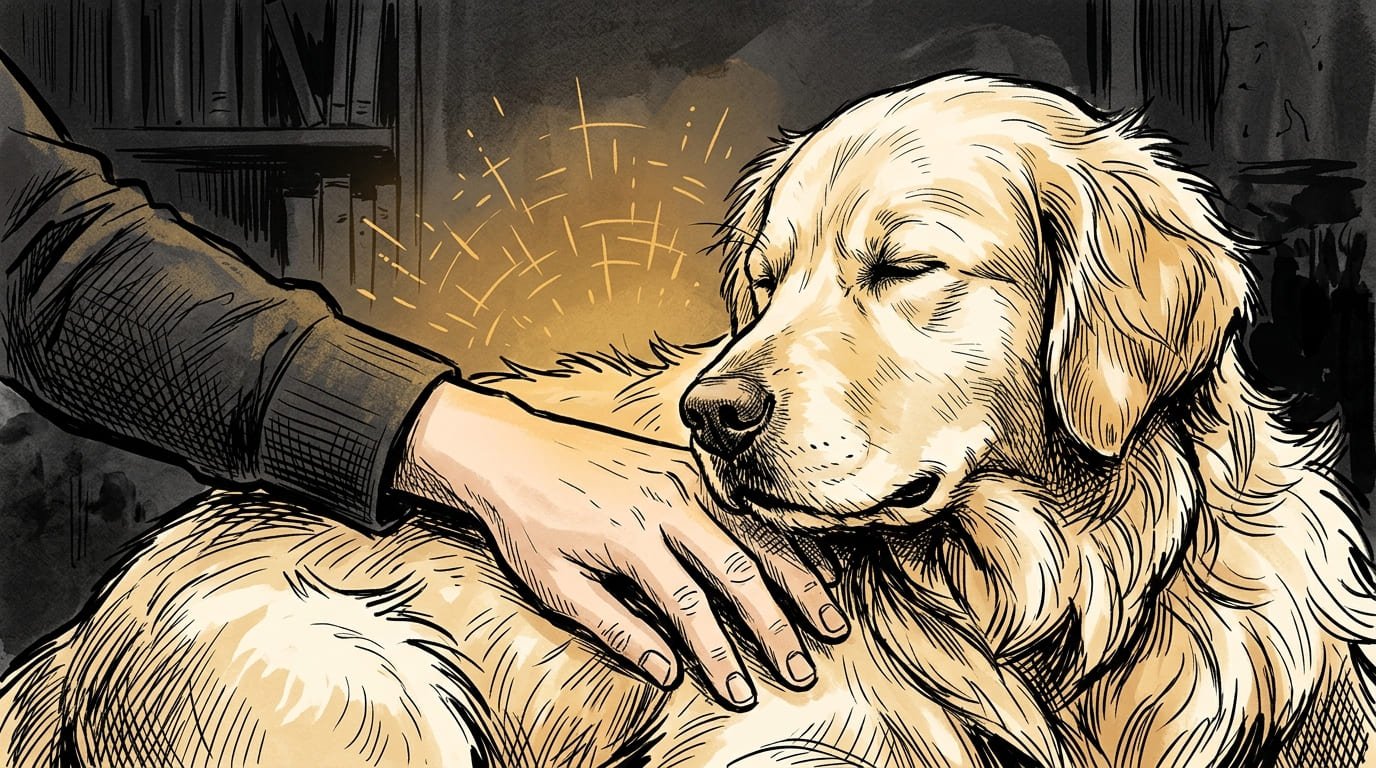
Your distress, not theirs. This is the trigger most owners have experienced but rarely name. Research from the University of London and studies published in Learning and Behavior found that dogs respond to human emotional distress with increased proximity-seeking — moving toward their person rather than away. A securely attached dog who senses their person is sad, anxious, or in pain will often press against them and go still. In this version, the dog isn’t seeking comfort. They’re offering it.
Why It’s Always You
Here’s the detail most people miss entirely: your dog doesn’t do this with everyone.
Research on canine attachment consistently shows that proximity-pressing behaviors are directed almost exclusively at a dog’s primary attachment figure — not every person in the house, not everyone who feeds them, but the one specific person their nervous system has bonded to.
A 2021 study published in Animal Cognition by researchers at the University of Naples observed dogs in a modified Strange Situation test with multiple familiar people present. The dogs showed clear preference, directing prolonged physical contact consistently toward one specific person, even when other familiar individuals were available. The study also found that dogs with the strongest, most securely classified attachment bonds showed the most specific and directed contact-seeking — meaning secure attachment doesn’t make a dog seek comfort from everyone more. It makes them seek their one person more precisely.
The dog who rests their head on your lap — only yours, in that particular way — isn’t displaying a generic comfort behavior. They’re displaying a bonded one, directed at you specifically, because your presence is doing something no one else’s does.
What This Means
Put together, the research describes something more precise than affection. When your dog rests their head on your lap and goes still, their cortisol is dropping, their heart rate variability is increasing, and their oxytocin is rising — every measurable marker of their internal state moving toward calm, because you’re there.
Science doesn’t quite use the word trust to describe this. But what it documents functions like trust at a biological level: a nervous system that has learned, through consistent experience, that one specific presence means safety — and that when that presence is available, the body moves toward it and rests.
That’s not built in one moment. It’s built across every ordinary, reliable interaction that didn’t feel significant at the time. The next time it happens, it’s worth letting it land rather than rushing past it — because what your dog is offering, in the only language their body has, is the clearest signal they have: you are the place I come to when the world is too much.
Want the complete science of what your dog feels about you? Get The Bond Guide — free, 5 chapters, 30 seconds to download.